Finding the right office for startups is one of the most consequential early decisions a founding team will make. The wrong choice burns runway. The right one accelerates hiring, sharpens culture, and signals credibility to investors and clients alike. This guide walks you through every step, from comparing coworking spaces to direct leases, to planning square footage, negotiating costs, and executing a build-out that actually works.
Why Your First Office Matters More Than You Think
Picture a six-person AI startup in San Francisco that spent its first year crammed around a kitchen table. In early 2024, the team signed for 1,200 square feet of private office space in SoMa-and within weeks, their interview close rate jumped noticeably. Candidates could finally see the company as real.
Your startup office isn’t just a place to sit. It shapes how your team collaborates, how clients perceive you, and whether top talent feels comfortable joining a company that’s still proving itself. Investors notice, too. A thoughtful workspace signals operational maturity without requiring a Fortune 500 budget.
The “right” space isn’t always the fanciest. It’s the one that matches your runway, growth plans, and work style. Startups need affordable and adaptable spaces for fast growth and teamwork, not marble lobbies.
Today, early stage teams generally choose from four options: coworking spaces, serviced offices, subleases, and direct leases. Each carries different trade-offs in cost, flexibility, and control. The sections below break down every dimension so you can make an informed call.
Ironside Building, LLC focuses on designing and building startup-ready office spaces in Southern California, but the principles in this guide apply whether you’re in NYC, San Francisco, or Orange County.

Coworking Spaces vs. Private Offices vs. Direct Leases
Many startups begin in coworking spaces and later graduate to private offices or a direct lease as headcount and funding grow. Understanding the spectrum helps you avoid overpaying or locking in too early.
Coworking spaces offer flexible, month-to-month memberships. You get plug-and-play desks, shared amenities, and common areas without a long term commitment. A hot desk in a wework location or independent operator in San Francisco’s mid market neighborhood might run $400–$600 per month, while a private desk costs more. Startups often seek coworking spaces for flexibility and lower upfront costs, and coworking spaces can reduce costs by up to 66% compared to traditional office setups because they bundle utilities, furniture, cleaning, and internet into one fee.
Serviced offices provide fully furnished spaces without long-term leases. You get private suites, a dedicated receptionist, meeting rooms, and IT support rolled into a single monthly invoice. Private serviced suites cost $1,000 to $1,500 per person per month in major markets-more than coworking but far less hassle than a build-out. These cater to seed through Series B companies that want their own space with privacy but aren’t ready for construction.
A sublease means taking over another company’s fitted-out space, often below market rent. You inherit furniture, layout, and sometimes a shorter remaining term. The value play is clear: lower cost and speed. The downside is limited ability to customize and a fixed end date you can’t extend.
A direct lease puts you in negotiation with a landlord for a raw or second-generation office. Traditional leases typically span five to twenty years, though many startups negotiate three- to five-year terms. You gain full control over design, branding, and layout, plus access to tenant improvement allowances and free rent periods. The trade-off is a bigger financial commitment and a longer timeline to move in.
In short: coworking maximizes flexibility, serviced offices balance privacy with simplicity, subleases offer cost savings, and direct leases deliver total control. Your funding stage and headcount trajectory should drive the choice.
Key Factors to Evaluate Before You Tour Office Space
Before calling a broker or booking coworking tours, founders should define three things: current headcount, 18-month hiring plan, and must-have features. Everything else flows from there.
Team size and growth. Key features for a startup office include flexible lease terms and scalable layouts. Allow at least 100 square feet per team member as a baseline. For engineering-heavy companies with monitors and equipment, plan for 150–200 usable square feet per person. If you’re ten people today and expect to be twenty in a year, scalability allows startups to easily add more desks or private offices as needed-so look for spaces with expansion options or adjacent suites.
Location and neighborhood. Locations close to public transport, clients, and talent are vital for recruitment. In San Francisco, SoMa puts you near other startups and like minded entrepreneurs; the financial district appeals to fintech companies close to enterprise clients. In NYC, areas around Madison Square Park, Hudson square, or Midtown attract creative teams and AI firms. The neighborhood you choose signals your brand and affects who applies to work for you.
Budget and runway. A common rule of thumb is keeping total occupancy cost below 8–12% of operating expenses. That includes rent, utilities, furniture, cleaning, and IT-not just the number on the lease.
Lease flexibility. Flexible lease terms allow startups to avoid long lock-ins due to changing team sizes. If you haven’t hit product-market fit yet, a 12-month serviced office or month-to-month coworking membership carries far less risk than long leases.
Infrastructure. High-speed internet is a necessity for startup offices. Startups should prioritize features that support hybrid work models, including conference rooms with AV gear, soundproof call rooms for remote clients, and 24/7 access for teams with flexible working hours. Meeting rooms and collaboration spaces are essential for client interactions and brainstorming.
How Much Office Space Does a Startup Really Need?
Square footage planning is usually either ignored or wildly overestimated by first-time founders. Getting it right saves thousands per year.
First, understand the difference between usable square footage and rentable square footage. Rentable square footage includes your pro-rated share of common areas like lobbies, corridors, and restrooms. A 5,000 RSF floor might only yield 3,800–4,200 USF after accounting for a typical 20–30% loss factor. Always ask for both numbers.
A common range is 150 to 250 usable square feet per person for teams that need individual workstations plus meeting rooms and support areas. Lean engineering teams running open-plan layouts can work at 120–160 USF per seat. Hybrid or desk-sharing models drop to 80–120 USF. Startup teams need about 100 square feet per person at the absolute minimum for hot-desking or very dense layouts.
Here’s a worked example: a 12-person startup planning to grow to 20 over 24 months. At 150 USF per person and a target of 20 seats, you’d want roughly 3,000 USF-which translates to approximately 3,750–3,900 RSF depending on building efficiency. To bridge the gap during growth, many startups keep a few dedicated desks in a nearby coworking space for overflow.
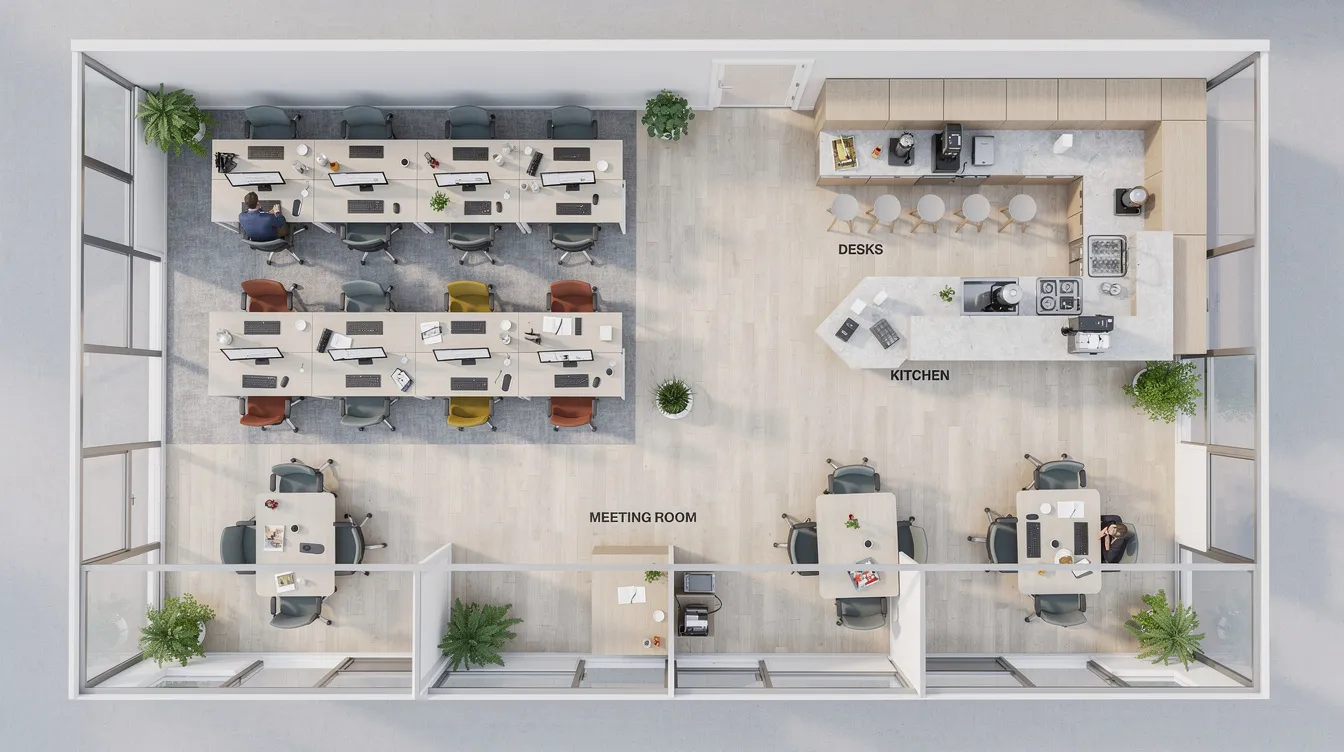
Beyond workstations, plan for rooms that growing teams actually use: two to three small huddle rooms for two to four people, one medium project room, one boardroom, phone booths or focus booths, a kitchen or lounge, and an IT/storage closet. These ancillary spaces typically add 20–30% to your raw workstation area.
Ironside Building helps Southern California startups test-fit plans and layout options before signing any direct lease or starting build-out, so founders don’t commit to the wrong footprint.
Cost Breakdown: From Rent to Hidden Occupancy Costs
Base rent is only one line item. Consider occupancy costs which can double your rent expenses once you factor in everything else, especially in markets like San Francisco, NYC, or Los Angeles.
Base rent. A 2,500 RSF direct lease at $60/SF/year in San Francisco’s mid market runs $150,000 annually. That same square footage in a Class A tower near Hudson yards in NYC might cost $90/SF/year, or $225,000. Midtown South averaged $88.32 per square foot in Q1 2026, making it one of the pricier corridors for startups eyeing midtown-adjacent addresses.
Building charges. In triple-net or modified gross lease structures, tenants pay property taxes, insurance, and common area maintenance on top of base rent. These add $8–$15/SF/year. Property taxes may be the tenant’s responsibility after the first year of the lease, which can surprise founders budgeting only for rent.
Interior costs. Furniture, conference room AV, access control systems, low-voltage cabling, and finish upgrades commonly run $30–$80/SF depending on scope. Build-out allowances reached up to $131.70 per foot in 2025 in top NYC buildings, which helps offset these expenses if you negotiate well.
Utilities and services. Electricity, HVAC, water, cleaning, and security are often separate in direct leases. Evaluating total occupancy costs includes utilities and internet in addition to rent. Coworking spaces often include utilities in monthly fees, which simplifies budgeting. Cost transparency is crucial to avoid hidden costs in startup office leases.
Side-by-side example. A 10-person team in a coworking space at $1,200 per desk pays roughly $144,000 per year, all in. That same team in a 2,000 RSF direct lease at $80/SF base rent pays $160,000 in rent, plus $20,000 in CAM/NNN, plus $100,000 in first-year build-out costs-$280,000 total in year one. Occupancy costs can double the price of the lease. The coworking route costs less upfront but more per person over time; the direct lease is front-loaded but cheaper at scale.
In 2025, NYC tech tenants averaged 13.3 months free rent on new leases, which dramatically reduces effective cost. Ironside Building creates detailed pre-construction budgets for Southern California build-outs so founders can see total three- to five-year cost of occupancy before committing.
Lease Structures: Coworking, Sublease, Serviced Office, or Direct Lease?
Lease structure determines your risk, flexibility, and how much control you have over the workspace you’re building a business inside.
Coworking memberships. Month-to-month coworking and 6- to 12-month suites are common arrangements. Coworking spaces allow startups to pay only for needed space, scaling from one hot desk to a cluster of dedicated desks as the team grows. Documentation is minimal-often just a license agreement. Many options exist across every major city.
Serviced office licenses. Terms typically run 6–24 months. You get private offices, shared meeting rooms, and a dedicated receptionist bundled into one fee. For example, a 10-person private suite in a serviced office in the financial district might cost $12,000–$15,000 per month all in. Shorter lease terms keep startups flexible during growth.
Subleases. You inherit the previous tenant’s remaining term, furniture, and layout. Over a third of recent SoMa office deals are under one year, reflecting how many companies are subleasing space they no longer need. Review the remaining term, assignment rights, and restoration obligations carefully before you sign.
Direct leases. These involve three- to ten-year commitments with tenant improvement allowances, free rent periods, and security deposits (often three to six months of rent for early-stage companies). Negotiating lease terms can include adjustments beyond just rent-TI dollars, expansion rights, early termination clauses, and rent escalation caps. Startups can negotiate expansion rights in their leases to lock in adjacent space for future growth. In NYC, deals often require personal guarantees, so experienced legal counsel is worth the money.
Designing a Startup Office That Actually Works
Office design significantly affects startup productivity and morale. It’s not about trendy furniture-it’s about creating zones that support the way your team actually works.
Functional zoning. Separate your floor into quiet focus areas, collaboration zones, and social spaces like kitchens or lounges. Open spaces encourage collaboration and creativity, while dedicated quiet zones protect deep work. A cluttered office can lead to anxiety, so build in enough storage and keep circulation paths clear. Intentional office design can inspire and engage employees to do their best work.
Meeting room strategy. For a 10–20 person startup, two to three small huddle rooms and one boardroom outperform a single oversized conference room that sits empty most of the day. Access to collaborative areas and private rooms fosters productivity in startup environments.
Acoustics and privacy. Sound-masking systems, phone booths with solid-core doors, and strategic placement of noisy functions-kitchens, printers-away from heads-down work areas make a measurable difference. Employees who can feel comfortable focusing without headphones are more productive.
Brand and culture. Your entry sequence, color palette, materials, and signage should reflect your company’s product and values. Keep finishes adaptable so you can evolve the space as the startup matures. This is where entrepreneurs can build a strong sense of identity without overinvesting in permanent fixtures.
Ironside Building coordinates test-fits, interior design, and build-out for startup offices across Southern California, including tenant improvement projects in multi-tenant buildings where landlord standards must be met.

Infrastructure, Technology, and Future-Proofing Your Space
Many startups underestimate what their office needs to support dense laptops, AI workloads, and hybrid meeting habits.
Power and cooling. Engineering teams with multiple monitors and high-performance machines draw serious wattage. Confirm electrical capacity with the building engineer before finalizing layouts. Overloaded circuits mean tripped breakers and lost work.
Connectivity. Providing reliable technology such as secure networks is essential for startups. Dual fiber providers, properly designed Wi-Fi coverage, and structured cabling prevent dead zones and outages. A 30-person engineering team should have redundant fiber and dedicated bandwidth for meeting rooms to avoid video call dropouts during all-hands.
Access control and security. Badge systems, visitor management, and IT closet security matter-especially for companies handling sensitive client data. These systems should be specified during build-out, not bolted on afterward.
Hybrid work. Reliable video conferencing gear in every meeting room, soundproof booths for remote calls, and areas designed for mixed in-person and remote collaboration are table stakes for modern startups.
Ironside Building coordinates low-voltage, AV, and security trades during Southern California build-outs to avoid change orders and retrofit headaches down the road.
Location Spotlights: San Francisco, New York, and Southern California
Markets differ dramatically in rent, building stock, and community. Here’s a snapshot of what startup owners face in each region.
San Francisco. SoMa and mid market remain the default startup districts, with average asking rents around $66–$73/SF/year for office space and vacancy rates near 30%. Mission Bay commands $90–$100+/SF. Shared spaces in these neighborhoods let founders expand their network among like minded entrepreneurs. Loft-style buildings with generous ceiling height appeal to creative teams, while towers in the financial district house enterprise-focused companies.
New York. Corridors like hudson yards, the Flatiron area, and hudson square attract AI, fintech, and creative tech startups. Class A asking rents in midtown run $84–$90/SF/year, though effective rents drop after concessions. Coworking fosters networking opportunities among diverse professionals in NYC’s dense startup ecosystem. A professional address and on-demand meeting rooms can be provided by virtual offices for founders not yet ready to commit to a physical space. Shared common areas in many NYC buildings can facilitate networking among entrepreneurs across industries. Coworking spaces foster collaboration among diverse professionals, making the city a hub for ideas and community.
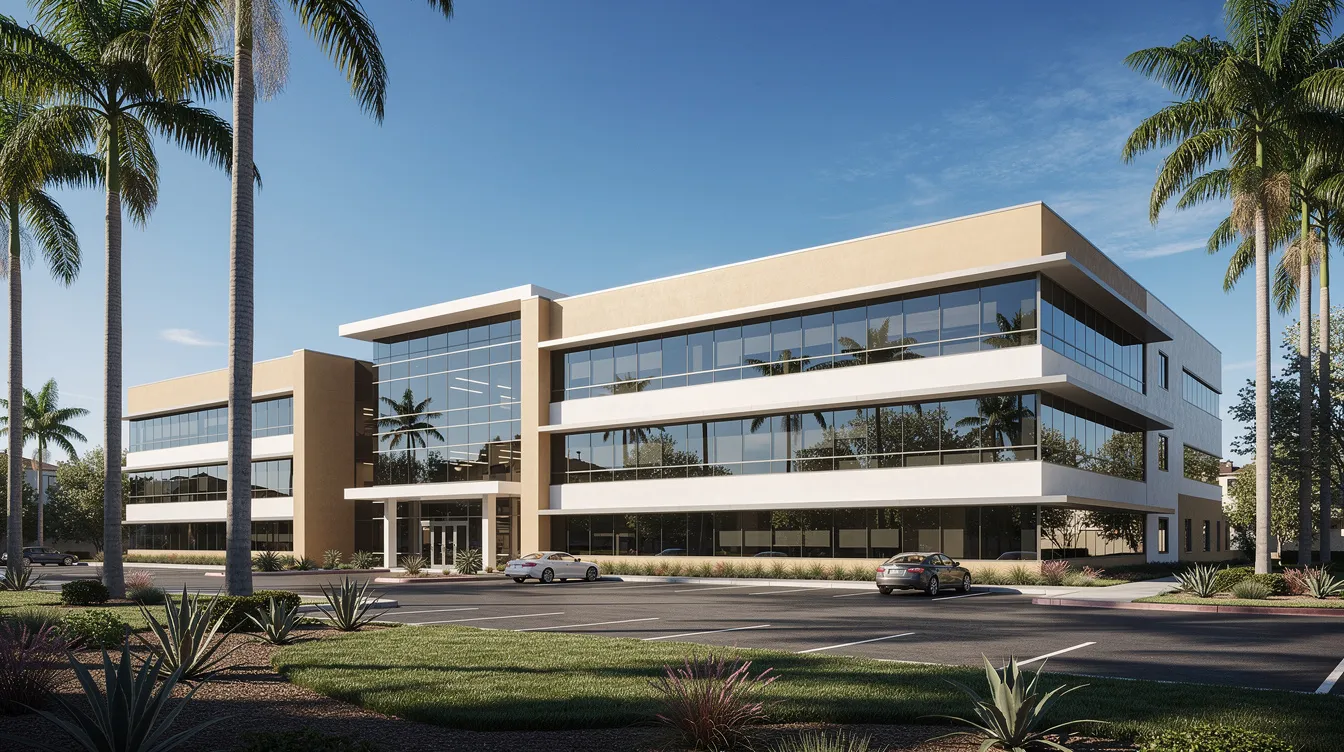
Southern California. In Irvine, Costa Mesa, and greater Orange County, startups often occupy flex industrial, low-rise office parks, or mixed-use spaces with rents in the $40–$70/SF/year range. Direct access to outdoor areas, strong parking ratios, and lower build-out costs make the region attractive for growing teams. Ironside Building helps Southern California companies translate big-market best practices into locally optimized workspaces.
From Blank Shell to Finished Office: The Build-Out Process
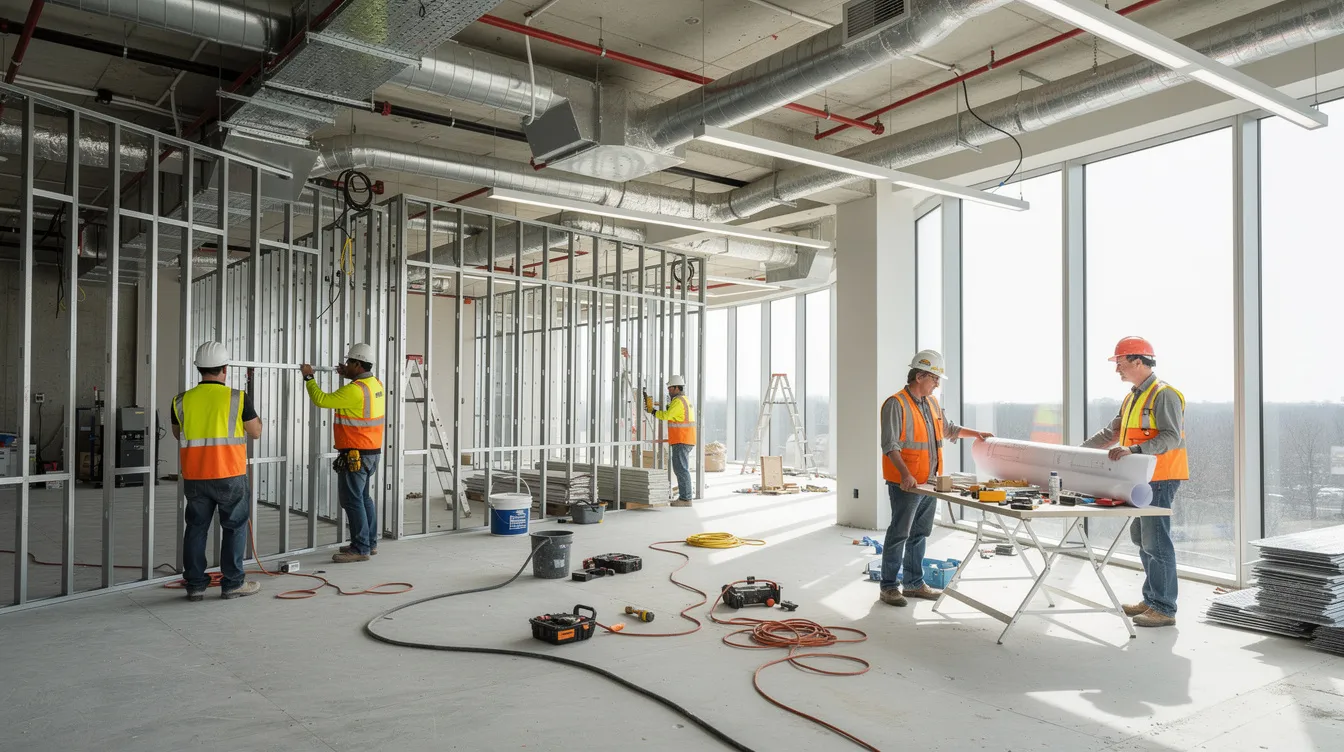
Taking a raw cold shell or second-generation office and turning it into a finished workspace typically takes 12–20 weeks for spaces under 10,000 square feet.
Phase 1: Planning. Site evaluation, test-fit layouts, and preliminary budgeting happen before construction. This is where you align the space to your headcount, workflow, and budget. Early design decisions-like where to place the server closet or whether to build seven rooms or four-save real money later.
Phase 2: Budgeting and permits. Value engineering trims costs without sacrificing function. Permit drawings go to the city for approval-a process that can take two to six weeks in California depending on jurisdiction.
Phase 3: Construction. Partitions, ceilings, lighting, HVAC distribution, finishes, millwork, and low-voltage/IT cabling are installed. For a 2,000–5,000 square foot office, active construction runs six to ten weeks. Mid-size spaces (10,000–20,000 square feet) take longer.
Phase 4: Inspections and punch-list. Final building inspections, fire-life-safety sign-off, and punch-list corrections wrap up the project before move-in.
Tenant improvement allowances from landlords in Class A and B buildings can range from $60–$130/SF in exchange for longer lease terms, directly offsetting construction costs. Ironside Building serves as a full-service general contractor in Southern California, coordinating architecture, engineering, permitting, and construction to keep startup projects on budget and on schedule.
Working with a General Contractor Like Ironside Building
A specialized commercial contractor is critical for first-time offices and tenant improvements, especially when founders lack construction experience and can’t afford to learn through expensive mistakes.
Ironside Building typically engages early-reviewing test-fits, analyzing lease language related to TI scope, and providing preliminary budgets before leases are signed. This prevents founders from committing to a space that costs far more to build out than expected.
During construction, project management responsibilities include scheduling, trade coordination, safety compliance, inspections, and weekly progress updates. Busy founders stay informed without getting dragged into technical details that pull focus from running the business.
Risk management is a major component: code compliance, ADA accessibility, fire-life-safety requirements, and landlord standards must all be met to secure a certificate of occupancy. In one recent Southern California project, early GC involvement caught a mechanical conflict that would have added six figures in retrofit costs had it surfaced during construction.
Ironside Building positions itself as a long-term partner-from initial office build-out to later expansions, renovations, or relocations as the startup scales from five to fifty-plus employees.
Action Plan: Choosing and Building Your Startup Office
The right startup office space comes down to four decisions made well: right size, right lease type, right design, and right build-out partner. Here’s your playbook.
- Define headcount and runway. Know your current team size and realistic 18-month hiring plan. Back into a monthly occupancy budget.
- Shortlist neighborhoods. Pick two to three areas based on transit, talent, and client proximity.
- Set a total occupancy budget. Include rent, CAM, utilities, furniture, IT, and build-out-not just asking rent.
- Choose your product type. Coworking for pre-product-market-fit. Serviced offices for seed to Series A. Direct lease for Series B and beyond.
- Test-fit and budget. Have a contractor or space planner validate that your target space supports your layout and headcount goals.
- Negotiate lease and TI. Push for free rent, TI dollars, expansion rights, and capped escalations.
- Hire a contractor and execute. Engage a general contractor early to lock in scope, schedule, and budget.
Time your move-in around product and hiring milestones. Signing a lease three to six months before a planned headcount ramp gives you time to build out without paying rent on empty space for too long.
If you’re a Southern California startup ready to find, plan, and build your ideal office space, reach out to Ironside Building. We’ll help you evaluate spaces, plan layouts, and deliver a turnkey workspace so you can focus on scaling your business.